Showing posts with label Arrow Academy. Show all posts

Tuesday, 11 July 2017

Blu-ray Review: One-Eyed Jacks


Based on Charles Neider's novel "The Authentic Death of Hendry Jones", "One-Eyed Jacks" was originally slated for Stanley Kubrick to direct.
Instead, the baton was handed to Marlon Brando for his first and only film as director. Guy Trosper and Brando wrote the screenplay, which turned out to be
a major revision of its source, and the film is now widely regarded as a masterpiece.


Brando himself headlines as Rio; a headstrong apprentice to Dad Longworth (Karl Malden). Together, the pair stage holdups which relieve law abiding folks of cash and jewellery.
Their latest heist - two bags of gold from a bank - sees them chased out of town by Mexican mounted police.
Holed up in the mountains and facing seemingly insurmountable odds, the pair decide one of them will strike out in search of fresh horses after Rio's mount is killed,
leaving the other to wait behind in a perilous situation.
Dad rides off into the sunset, never to return, leaving Rio to be captured with a jail term the result of his trust.
Deprivation of freedom, instigated by a revered friend, must have been a bitter pill that proved impossible to swallow and Rio escapes after 5 years in jail, with a burning desire for revenge.
Rio is soon on course for a long-awaited reunion when a conversation with outlaw Bob Amory (Ben Johnson) points him at towards the town of Montorey.
During the town's annual fiesta, the bank closes for two days,leaving potentially rich picking for Rio and his gang.
Rio soon gets the chance to meet with Dad, who is Sheriff of the town. During one of many memorable scenes, Rio rides out to call on Dad, with the latter resting on his front porch, observing Rio from behind bars reminding Rio of the jail that accounted for 5 years of his life.
There's now a real hatred between the pair, but love soon rears its head as Rio and Longworth's stepdaughter Louise (Pina Pellicer) fall for each other, leaving Rio with a choice to make.


Relationships old and new play a key part in proceedings here, with even Dad and his wife (played by Katy Jurado) clashing over Dad's increasingly cruel behaviour.
Witness the scene where Rio is brutally whipped and has his trigger hand badly damaged by his former friend, making Dad a particularly odious villain, closely followed by Amory and Slim Pickens' sleazy deputy in the forces of evil stakes.
Even Rio has his dark side, and it's fascinating to observe his good and bad splits fighting to hold sway.
Brando quite simply was superb on both sides of the camera, and if one approached this film with no prior knowledge, it would be difficult to discern anything other than the director was a seasoned filmmaker.
While it's true that "One-Eyed Jacks" went over budget - some 5 hours of footage no longer exists - the end result is a treat for the eyes, with Brando's wait for magic hour shots and the right kind of waves paying dividends.
Here, the photography of Charles Long Jr uses deep focus shots and panoramic sweep to capture cast and scenery in exemplary fashion.
This was the last Paramount film to be shot in Vistavision, and we must be thankful that Martin Scorsese and Steven Spielberg made this stunning restoration possible, banishing previously inadequate home video versions.


Aspiring actors and directors would do well to study this film, while the rest of us will be enthralled while possibly regretting this was Brando's only time in the director's chair. Maybe his standoff with Paramount regrading the ending left a bitter taste that wouldn't wash away?
Whatever the reason, he certainly made his mark as an accomplished director and his film remains one of the great Westerns.


The 4K rstoration on Arrow Academy's Blu-ray presentation is, along with "Bring Me The Head of Alfredo Garcia", one of this year's best.
Interior and exterior scenes boast fine detail, warm colours and, at times, are simply breathtaking.
The supplementary features begin with a commentary track from author Stephen Price who wrote "Savage Cinema: Sam Peckinpah and the Rise of Ultraviolent Movies."
Stephen picks out Peckinpah's influence on the script; draws comparisons with other westerns; talks about the revised ending and praises Brando's meticulous approach to filming. It's an enjoyable, highly informative track.

"Marlon Brando: The Wild One." (53m 43s)
This documentary was originally broadcast by Channel 4 on 11th August, 1996. Martin Sheen, Dennis Hopper, Shelley Winters, Francis Ford Coppola and Arthur Penn
are just some of the artists interviewed in this valuable tribute to Brando.
The actors studio, early stagework and just what it was like to be touched by Brando's brilliance are all discussed, with clips from the likes of "On The Waterfront",
"A Streetcar Named Desire" and "Last Tango In Paris". Paul Joyce's absorbing documentary is required viewing for all Brando buffs, with great stories and insight from those who were there when the magic happened.

"Francis Ford Coppola on Marlon Brando." (48m 30s)
Paul Joyce interviews Francis, who talks about a genius he rates alongside Welles and Kurosawa, and who left a legacy for actors everywhere.
We hear about how Brando landed the "One-Eyed Jacks" gig and of course, there's plenty of insight and anecdotes regarding "The Godfather". Coppola had a tough battle to
add Brando to his fine cast, and goes into the trials and tribulations of coming up against a stubborn film company.

"Arthur Penn on Marlon Brando>" (44m 49s)
Once again, Paul Joyce takes the microphone for another interview. As with Coppola, his Arthur Penn interview was recorded for the documentary, comprising of familiar material with plenty of additions. Brando's work with Stella Adler; his improvisational skills regarding the intent of words and the first time Penn saw Brando at work are just some of the areas discussed. It's also well worth a second hearing regarding Penn's ice cube story and Coppola's 'gong' gag.
There's also a 2m 55s introduction to the film by Martin Scorsese, and a 4m 44s trailer.

Arrow includes, on this first pressing only, a collectors booklet (which I haven't seen) containing new writing on the film by Jason Wood and Filippo Olivieri; Karl Malden on Marlon Brando; Paul Joyce on "Marlon Brando: The Wild One" and an excerpt from Stefan Kanfer's "Somebody: The Reckless Life and Remarkable Career of Marlon Brando."

"One-Eyed Jacks" is available to buy now, and a surefire contender for those 'Discs of the Year' lists.

Friday, 15 April 2016

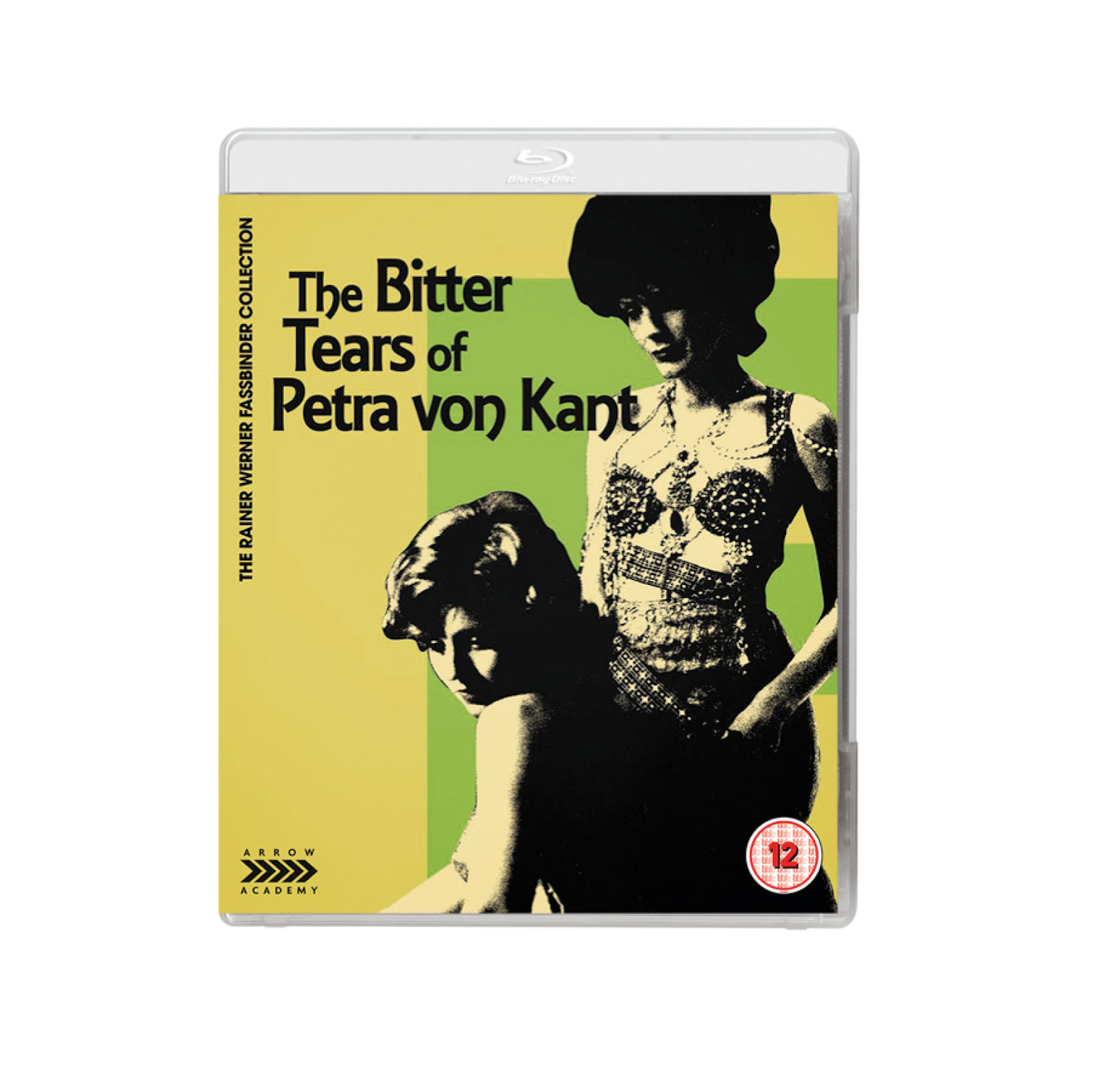
Blu-Ray Review: The Bitter Tears of Petra von Kant


Based on Fassbinder's own play, "The Bitter Tears of Petra von Kant" is set entirely in the bedroom of a Bremen apartment where Petra (Margit Carstensen) busies herself with a successful career as a fashion designer.
We see the cruel side of Petra early on with her callous treatment of servant Marlene (Irm Hermann), and go on to witness a draining downwards spiral as friends, family and a new lover are introduced to us via the all-female cast.
Petra's previous relationships are discussed with Sidonie (Katrin Schaake) while Marlene stands in the background, listening intently as silent witness to stories which contain fabrications, judging by the servant's facial expressions.
Another visitor to Petra's centre of her universe is Karin Thimm (Hanna Schygulla); a 23 year-old beauty who casts a spell over her host, and becomes her lover following Petra's promise to help turn her into a top model.
Before long, their relationship turns sour, with Karin's treatment of Petra becoming similar to the verbal abuse suffered by Marlene, and the introduction of Petra's mother (Gisela Fackeldey) and daughter Gabriele (Eva Mattes) further increases the harsh words and actions that pour out of Petra.


Overall, this is an emotionally draining film, driven by beautifully tuned performances and Michael Ballhaus' photography and lighting.
The bedroom features a reproduction of a painting - 'Midas and Bacchus' by Nicolas Poussin - which, along with Petra's bed, becomes another character in the film, sometimes dominating and always acting as a jury, deliberating on the events with eyes that watch from hundreds of years ago.
Towards the end of the film, life really does imitate art as the occupants of Petra's bedroom practically mirroring the imposing artwork.
The room itself is, by turn, claustrophobic, and sometimes really opens up to characters and their audience, while remaining within the wing of Fassbinder's theatrical direction.
The performances, too, are sympathetic to the story, conveying a multitude of emotions as real despair kicks in.
While Carstensen and Schygulla both excel in their roles, Irm Hermann deserves much praise for her portrayal of Marlene, who sometimes takes the guise of one of Petra's paintings, adopting still-life poses as real life turmoil surrounds her.Whether it's sketching designs for Petra, acting as nurse or simply through the clickety-clack of her typewriter keys, she's always there, right up to the finale which sheds some light on her tolerance of Petra's behaviour.

This is top-tier Fassbinder, and ripe for the kind of re-appraisal found in Diane Charleson's excellent commentary track found on Arrow Aacadmey's Blu-ray.
Diane looks at Fassbinder's turbulent family life; influences drawn from American melodrama and Bergman's "Persona"; points out the triangular relationships reflected in the framing; discusses the absence of men in the film and also praises Michael Ballhaus for the fluidity he brought to this production.
It's a stimulating, highly informative track and one that you should return to.

Next up is 'Life Stories: A Conversation With R.W. Fassbinder'. Made for German television in 1978 and moderated by Peter W. Jensen, the interview runs for 48m 29s.
Fassbinder talks about his childhood, his marriage; the reduction of freedom in Germany at the time and of his second home in Paris, declaring he felt more at home there.
"Berlin Alexanderplatz" is also mentioned, and he addresses why his films were not widely known at the time.
It's an enlightening piece, tinged with sadness that Fassbinder died at such a young age.

'Role-Play" Women On Fassbinder' (58m 41s)
Here, Carstensen, Schygulla, Hermann and Rosel Zech paint a picture of what is was like working with a genius who tore of the masks of those he was with.
Hermann talks about their marriage, and why she broke up with him while Schgulla declares his actresses were like "figures on a chess board".
A temperamental, highly focused individual was was a real genius emerges from the memories of some of the ladies who knew him best.
A valuable disc extra indeed.

Once again, this 4K restoration from original camera negatives yields impressive results with a beautiful film-like presentation.
"The Bitter Tears of Petra von Kant is available to buy now. Another great addition to Arrow Academy's catalogue.

Saturday, 2 April 2016

Blu-ray Review: The Merchant Of Four Seasons/Beware Of A Holy Whore (Arrow Academy)

Arrow Academy has just released a boxset devoted to the films of Rainer Werner Fassbinder, containing 7 Blu-ray discs which cover 10 of his films.

Limited edition box set (1,000 copies) containing Love is Colder Than Death, Katzelmacher, Beware of a Holy Whore, The Merchant of Four Seasons, The Bitter Tears of Petra von Kant, Fear Eats the Soul, Effi Briest, Fox and His Friends, Chinese Roulette and The Marriage of Maria Braun
Brand new 4K restorations of the films from original camera negatives
High Definition Blu-ray (1080p) presentations
Original uncompressed PCM mono audio
Optional English subtitles on all films
Six audio commentaries: Adrian Martin on Beware of a Holy Whore, Alexandra Heller-Nicholas and Christian McCrea on The Merchant of Four Seasons, Diane Charleson on The Bitter Tears of Petra von Kant, Mark Freeman on Fear Eats the Soul, Ken Moulden on Effi Briest and Hamish Ford on Fox and His Friends
Two early short films by Rainer Werner Fassbinder from 1966, The Little Chaos and The City Tramp
My Name is Not Ali, Viola Shafik’s 2011 feature-length documentary on the life and death of El Hedi ben Salem, star of Fear Eats the Soul
Newly-filmed interview with actor Lou Castel on Beware of a Holy Whore
Newly-filmed interviews with actor Ulli Lommel on Love is Colder Than Death, Effi Briest and Chinese Roulette
Newly-filmed interviews with director of photography Jürgen Jürges on Fear Eats the Soul and Effi Briest
The Rainer Werner Fassbinder Family, an all-new featurette detailing the actors who worked with Fassbinder time and again throughout his career
Life Stories: A Conversation with R.W. Fassbinder, a 50-minute interview with the director conducted for German television in 1978
End of the Commune, Joachim von Mengershausen’s 1970 documentary portrait of Fassbinder and his troupe including rare footage of his actors rehearsing and Love is Colder Than Death’s premiere at the 1969 Berlin Film Festival
Role-Play: Women on Fassbinder, a 1992 documentary containing interviews with four of the director’s leading ladies, Margit Carstensen, Irm Hermann, Hanna Schygulla and Rosel Zech
Life, Love & Celluloid, a 1998 feature-length documentary on Fassbinder, written and directed by his regular editor, Juliane Lorenz
Rainer Werner Fassbinder, 1977, a candid 30-minute interview with the director
Original theatrical trailers for Katzelmacher, Beware of a Holy Whore, Fear Eats the Soul, Fox and His Friends and Chinese Roulette
200-page hardback book, exclusive to this limited edition box set, containing all-new writing by Tony Rayns, Gertrud Koch, Michael Pattison, Nick Pinkerton, Ashley Clark, Erica Carter, Alex Davidson, Glenn Kenny and Margaret Deriaz

The films are also being released individually throughout 2016.


Although he passed away at the absurdly young age of 37, Fassbinder had an astonishingly prolific career and these releases are essential for followers of world cinema.
During the next few weeks, I'll be taking a look at five of these films.

The Merchant Of Four Seasons


"The good die young and people like you come back."

When Hans Epp (Hans Hirschmuller) returns from a year away in the Foreign Legion, his mother (Gusti Kreissi) with the hostility of a bitter woman whose son has fallen well short of expectations.
Hans peddles fruit through the streets of Munich, aided by his wife Irmgard (Irm Hermann) who is determined to make ends meet for their young daughter and also for their marriage.
Hans has an alcohol problem, and we first see his real devotion to the demon drink when Irmgard interrupts a heavy session with his cronies, only to have a chair thrown at her, followed by a beating when he eventually gets home.
One heart attack later, and Hans' drinking and heavy lifting at work are curtailed by a Doctor's warning that drink and physical exertion will be fatal.
So, Hans and his wife hire a labourer to work the rounds. Before long, the money is rolling in but further unhappiness lies just around the corner.

It's grim subject matter to be sure, but compulsive vewing thanks to the excellent cast who represent family and a band of outsiders who all have a part to play in this sad story.
Hirschmuller is very good as the ticking clock that is Hans, earning both sympathy and disgust for the choices he makes.
His family - Heide Simon as his married sister, brother-in-law Kurt played by Kurt Raab and sister Anna, the brutally honest one (Hanna Schygulla) - are dysfunctional in the extreme, while the hired help enter the picture with cold, calculating parts to play.
Top billing, for me, has to be Irm Hermann wo delivers a beautifully multi-layered performance, packing in all the emotions as she fights to keep the family unit together. Joy, pain, despair and a very real fear are all present and conveyed so very well.
Praise, too, for Ingrid Caven as Hans' great love. Her screen time may be limited but she leaves her mark like a stash of old letters that silently chronicle a love that could never be.
All of these actors are well served by the photography of Dietrich Lohmann whose exquisite framing helps make this a true work of art.
Highlights are many, but my own choice for the most affecting is the shot that follows a distraught Irmgard as she heads home through darkened streets past a variety of shops; one of which sells bridal gowns that should mark the beginning of a joyous union. Unbearably sad.
Those of you yet to experience a Fassbinder film, and who have perhaps been alerted by Arrow's deluxe treatment of other important director figures, may well find this a good place to begin.


"The Merchant Of Four Seasons" is accompanied by a commentary track from Alexandra Heller-Nicholas and Christian McCrae.
The pair combine well to deliver a track that will stimulate and inform newcomers and seasoned Fassbinder buffs alike.
We hear about the core issues Fassbinder brought to the table; the discomfort created by certain scenes in this film;
a funny story concerning the director's 8 month hiatus prior to shooting Merchant and analysis of when the films moves from cinematic to theatrical.
There's also praise for Hermann's performance; exploration of Fassbinder's attitude towards women - the director's own words being quoted on several occasions which adds to the wealth of information complied - and critical reaction to the film, which is sometimes challenged.
This serves for a lively, informative track that manages to fit in cast and crew information, and director's Fassbinder inuluenced and was influenced by, including Michael Mann and Douglas Sirk. Listen out, too, for Alexandra's wonderful description "a parody of mourning". A job well done.

Beware Of A Holy Whore


Rainer Werner Fassbinder's tenth film - an engrossing study of a film shoot from hell - was set in Spain and shot in Italy, and that's a consideration when one studies the sense of dislocation that's prevalent in this picture.
Lou Castel plays Jeff, director of this film-within-a-film and one of the few people to have a identifiable role in proceedings.
Jeff arrives on the set to find a motley collection of cast and crew - some interchangeable - who congregate around of bar area of the hotel lobby where they consume copious quantities of alcohol, while lust, jealousy and violence hang heavy in the air.
We have Fassbinder himself playing what appears to be the producer; Hanna Schygulla as a Monroe-esque Goddess clad in white; Eddie Constantine playing himself, effortlessly conveying real star quality; Uli Lommel's wanna-be director and a cast of supporting players who mostly become infected by the creeping moral malaise which covers this film.
Jeff's project is pitched as being against a certain kind of brutality that's sanctioned by the state, and includes two brutal murders which involve Constantine who initially draws the line at performing his characters deadly work.

The first half of "Beware Of A Holy Whore" is composed of long takes, while the second half contains a multitude of shorter scenes that jump about to such an extent, it's often confusing to get a handle on what's happening and when it occurred. For all that, it's a stimulating piece of work that presents the madness of a film set where missing materials, bouncing cheques and various warring factions combine to push the director towards the edge.
Once again, Fassbinder moves between the cinematic and the theatrical with beautifully composed framing shots from the director and his DOP Michael Ballhaus.
In many ways, "Beware Of A Holy Whore" would make for a compelling double bill with Abel Ferrara's "Snake Eyes" (aka "Dangerous Game") with the human wreckage of an ugly shoot ready to explode at any moment.

The excellent Adrian Martin takes the microphone for a commentary track that begins by examining a story from Werner Schroeter at the beginning of the film, and Adrian also notes how many of the cast were already film directors (including Schroeter) or would eventually move into this field.
Adrian talks about Fassbinder's early career; the connection between Beware and "Whity"; the director's use of music in this film; points out the influence of Sirk, Ray, Godard and Warhol in a commentary that takes in everything from the fragmented approach of the second half Of Beware to individual performances.
Listen to this and you'll immediately want to watch the film again.

A 2m 41s theatrical trailer is followed by "Castel As Fassbinder". This 9m 53s interview includes the story of how Lou eventually got tthe role of Jeff; his thoughts on working with the late director and his verdict on the film.
It's a nice way to end a disc that provides beautiful 4K restorations of both films.


Sunday, 21 February 2016

Blu-ray Review: The Jacques Rivette Collection (Arrow Academy)


Jacques Rivette sadly passed away on 29th January 2016, and left a rich body of work to study and savour for all time.
Rivette began his career as a film critic, going on to become a director and part of the famous French New Wave.
Arrow Acadmey's Blu-ray set celebrates the work of this innovative filmmaker with some top-tier films, including a legendary project that runs for almost 13 hours. This is our first port of call here.

Out 1: Noli Me Tangere


Made in 1970, Jacques Rivette's elusive film has received only sporadic screenings down the years, remaining a 'Holy Grail' for cinephiles.
"Out 1" comprises of 8 episodes that vary in length, from 73 minutes to 109, with the majority hovering around the 100 minute mark.
It's a hefty viewing commitment, but let me say right from the word go that it's absolutely worth every second of your time.


"Out 1" has many characters to identify and follow, beginning with two theatre groups, each rehearsing a play by Aeschylus: "Seven Against Thebes" and "Prometheus Bound". Their rehearsals are fascinating - sometimes frightening - to watch, with posture, delivery of lines and individual interpretation combining to produce intensive periods of work where anything can happen.
The Prometheus clan are led by Thomas (Michel Lonsdale); a serial-smoking intellectual who encourages his troupe to give themselves totally which results in exercises of terrifying physicality. Frequently, events threaten to spiral out of control, with the very real danger of someone getting badly hurt.
The Thebes group use literary and philosophical influences in search of how their performances should be shaped and - like Prometheus - it's fascinating to observe.
Later in the film, both groups are breached by an outsider: Prometheus by Thomas' friend Sarah (Bernadette Lafonte) who is enlisted partly to help remove a creative block, while Renaud (Alain Libolt) joins Thebes, only for the production to unravel.
Outside influences play a major part here, with two characters in particular making their mark: Colin (Jean-Pierre Leaud) first appears as a supposedly deaf mute who stamps 'business cards' which he presents at cafe tables, with the aim of collecting money, accompanied by blasts of his harmonica.
This ruse earns him a steady income, until one particular earning trip leads to him receiving the first of three cryptic notes. Rivette's film was inspired in part by Balzac's "La Comedie humaine" and the "History Of The Thirteen": 3 short novels concerning a powerful secret society in nineteenth-century France.
Lewis Carroll's "The Hunting Of The Snark" also served as an influence, and the sources combined send Colin on a mission. He suspects the notes allude to the nearby presence of a modern-day group, though his meeting with a Balzac expert (played by Eric Rohmer) fails to provide any answers. But, the search goes on, with Leaud delivering a brilliant physical performance that will stay with you.


The second character to encounter the shadowy world of 'The Thirteen' is Frederique (Juliet Berto); a young woman who again obtains money by deception, this time sweet-talking men out of their money, using her beauty and feminine wiles.
Frederique steals some letters during a memorable encounter with a near-neighbour, and their contents lead her into a situation that is simply to big for her to handle.
Throughout its 12 hour plus running time, "Out 1" is a delight to witness and never outstays its welcome.
I'd previously read that some may find the first two episodes heavy going, but can only say that i was hooked right from the start.
What makes this feature even more remarkable is the fact that the dialogue was almost completely improvised with the cast receiving little or no direction from Rivette, who used their performances to shape events and locations for the next days shoot.
As a result, we get cast members who are sometimes stuck for words, yet manage to recover and fully explore the freedom they've been given.
A case in point is a conversation between Emilie/Pauline (Bulle Ogier) and Sarah. Both actresses began with little or no idea on how to proceed, but their claustrophobic encounter is beautifully played. This scene runs for just over 15 minutes, and is one of many highlights. It's also exquisitely directed, using mirrors (a constant theme here)to highlight the boundary between fantasy and reality.
Emillie/Pauline is one of the key characters here. Her husband Igor has been missing for six months and, together with the enigmatic Pierre, casts a shadow over proceedings as Pauline makes a decision regarding the incriminating letters.
These letters and their significance introduce other important characters, including Lucie de Graaf (Francoise Fabian): a lawyer who laughs off Frederique's blackmail attempts, issuing a chilling warning as the identities of the groups members are gradually revealed.


Like "Prometheus", "Out 1" is a coded, complex work and offers infinite replay value with regard to characters, mood and motivation, punctuated by several short, sharp shocks and an approach reminiscent of Free Jazz at it's most hypnotic.
Rivette felt his magnum opus to be too powerful for TV, and put together an alternate cut titled "Spectre", which also appears in this collection and will be discussed a little later.

"The Mysteries Of Paris" 1:49:32s

A valuable documentary populated by key participants, including Rivette, Bulle Ogier, Michel Lonsdale, Stephane Tchal Gadsieff (producer) and Hermine Karagheuz (who features heavily in "Out 1").
The director talks about similarities between cinema and theatre; gives the lowdown on "Spectre" and acknowledges Jean Cocteau as the major inspiration behind his decision to become a film director.
Lonsdale recalls his beach breakdown was inspired by a scene from Fellini's "La Strada", while Ogier and Karagheuz - both still gorgeous - hold forth on Rivette's methods and the demands placed upon the cast.
It's a nice companion to the main feature, amplifying just how much of an achievement it was.

Out 1: Spectre


With a running time of approximately 4 hours 24 minutes, "Spectre" emerges as more than just a condensed version of "Out 1".
Here, you can discern subtle differences that increase appreciation of its lengthier sibling, while at the same time adding depth to characters portrayed by some very fine actors and actresses.
The rehearsals for "Prometheus Bound" and "Seven Against Thebes" are dramatically cut down, and while they provided absorbing viewing in the longer version, their absence here perhaps allows the film space to breathe and amplify the tension elsewhere. Some of my favourite scenes were also absent but again, this allows a greater degree of appreciation for other scenes and characters, such as Lucie and Emilie/Pauline.
Of course, details that one may have missed first time round can be picked up on such as the note advertising Bob Dylan bootleg albums in the window of 'L' Angle du Hasard' (the wonderfully named 'The Corner Of Chance'), or the mysterious footsteps and locked room at The Obade, possibly suggesting that at least one of the crew's missing members may be a lot closer than imagined.


"Spectre" is punctuated by a series of monochrome stills from the previous film, which combine with the live action - beautifully edited - to resemble a glimpse from a different world as though looking through a window. I felt a genuine sense of regret when both version ended.
I would most certainly recommend viewing the long version first, but if you're in a hurry, "Spectre" serves as a tasty primer before the main course.
The ending here works particularly well, with Jean-Pierre Leaud's final utterance an absolute joy, summing up his quest in 3 words. The final frames of the long version can also be seen in "Spectre", too.

Arrow's collection also includes 3 more films from this gifted director, and the next one in line is a real treat.

"Duelle"


Made in 1976 and with a running time of two hours, Jacques Rivette's "Duelle" is a bewitching and deliciously entertaining account of the lead up to a fateful duel between two goddesses's and a mortal.
It's Winter and the last night of the full moon when Lucie (Hermine Karahheuz) - a hotel night porter - welcomes a woman seeking a room for the night. Leni (Juliet Berto) is, to all intents and purposes, Lady Christie: partner of Lord Max Christie for seven years, and now seeking his whereabouts. Lucie is enlisted to do some strictly amateur detective work, which involves ticket girls from the Club Rumba, a woman named Sylvia Stern (Claire Nadeau) and brother Pierre (Jean Babilee) who worked with Lord Christie and is involved in the search for a Fairy Godmother stone that's been missing for 200 years.
Blonde Goddess Viva (Bulle Ogier) is another interested party, with possession of the stone enabling her to remain on earth.
Leni requires the stone for the same reason, as both are currently allowed to walk amongst us for just 40 days each year.

Queen Of The Sun vs Queen Of The Night is top of the bill here, as the first full moon of Spring draws ever closer, with Lucie and Pierre's hunt for the stone throwing up a dead body and some highly charged situations: do look out for the literally shattering scene involving one of Rivette's beloved mirrors.
Beautifully paced and superbly shot and lit by William Lubtchansky, "Duelle" is, for me, already one of this year's nicest surprises and far from being an also-ran in this collection.
It's a film that offers considerable replay value, offering a fascinating view of Paris at the time, with its story combining love, deception, murder and mystery, played out by a fine cast.
For many, this will be a first view of "Duelle" and it's quite a treat.

Remembering Duelle (10m 59s)

Bulle Ogier and Hermine Karagheuz return, this time recounting their experiences on "Duelle".
Hermine admits she's forgotten much about her role, but recalls a straightforward shoot, with a highly charged, mysterious atmosphere.
Bulle tells of her close relationship with Juliet Berto, and explains they had to keep their distance here so as not to affect their characters motivations.
Hermine also reveals she suffered from stage fright prior to filming. It's quite a moving experience to witness these fine actresses discussing their involvement in a film that can now be enjoyed by so many people.

Noroit


"Noroit" was shot in 1976 - the same year as "Duelle" - and was again lensed by William Lubtchansky.
It was shot on the Brittany coastline, centring on s small island where a brother and sister are washed up on the beach.
Morag (Geraldine Chaplin) awakens next to her brothers' lifeless body and for the next 134 minutes becomes embroiled in a mental and physical battle with pirate Queen Giulia (Bernadette Lafonte). Buried treasure -consisting of gold and diamonds plundered from vessels - lies at the centre of this wholly experimental work, allowing the director to once again indulge in his passion for constructing a trail leading to what lost hearts most desire.
"Noroit" is not the easiest Rivette film to get a handle on, but that doesn't make it any less worthy.

There's a poetic, other-wordly feel about this film that often reminded me of the work of Jean Rollin, and the striking on-camera musical trio greatly add to the air of improvisation and frequently demented turns by a cast that also includes Kika Markham and Humbert Balsam.
The beauty and mystery of the island are expertly captured by Lubtchansky, with magic hour shots, picturesque surroundings and exquisite interior details making this visually stimulating.

While it's true that "Noroit" - partly based on Cyril Tourneur's "The Revenger's Tragedy" - does take time to cast its spell, it is most certainly worth perseverance, with Chaplin at the centre using looks and gestures that say just as much as the lines she delivers.
By turn infuriating and captivating, "Noroit" looks ravishing in this splendid home video incarnation, and an essential port of call for those in search of unorthodox adventure.

Merry-go-Round


The final film in this most special collection was made in 1981, running for 160 minutes.
Maria Schneider was keen to appear in a Rivette film, and pushed for Joe Dallesandro to co-star.
Unfortunately, the production ran anything but smoothly, with Rivette deeming it to be probably his worst film.
"Merry-Go-Round" begins with Ben Phillips (Dallesandro) arriving in Paris to meet Leo (Schneider), this sister of his girlfriend Elisabeth (Daniele Gegauff).
Their father David Hoffman stole four million dollars before he was reportedly killed in an accident.
A former mistress of his is hot on the tail of the missing cash, with Ben, Leo and Elisabeth also following the trail.
When Elisabeth is abducted, the two leads must attempt to locate her whereabouts and join up the dots in another of the director's treasure hunts.


While Schneider and Dallesandro began this film as firm friends, their relationship took a turn for the worst, with Schneider frequently threatening to leave the production.
Add to this an often confusing screenplay, and you hardly have a recipe for success.
Well, I'd certainly argue that "Merry-Go-Round" deserves its place in this collection, being a slow-burner that requires several viewings to fully appreciate.
Dallesandro and Francoise Prevost (who plays scheming lawyer Novick) are well worth watching, and even the off-par Schneider commands attention. Add to this Michel Berto, Humbert Balsam and the wonderful Hermine Karagheuz and you have a cast that largely makes the best out of what they were given.
There are several scenes that will stay with you, too.Check out the dinner table scene - exquisitely shot and lit by William Lubtchansky - the sequence where a character uses clairvoyant powers to eerily describe a fateful event taking place out of sight and Ben's flight through the woods with hunters in pursuit.
There's a very good film here that's struggling to get out, but there's more than enough to suggest repeat viewings will bring their own reward.

"Merry-Go-Round" is followed by some valuable supplementary material.

Scenes From A Parallel Life (51m 43s)
This is comprised of two Jacques Rivette interviews. Both ultra-rare.
The late director talks about his unfinished four film project; the woes associated with the "Merry-Go-Round" shoot; some of the actresses he's worked with; the music in his films, and speaks in glowing terms about William Lubtchansky. He also states that he believes his audience to be made up of intelligent people who have their wits about them.


Rosenbaum On Rivette (2m 25s)
Here, revered film critic Jonathan Rosenbaum talks about "Duelle", "Noroit" and "Merry-Go-Round", explaining this trio of films had a bad effect on Rivette's career, largely due to critical reaction.
Jonathan discusses the use of music in these films, and of the interaction between actors and musicians. He also provides an insiders knowledge and appreciation of "Duelle" and "Noroit", having been on-set for both.
It's a stimulating and informative video essay, and one you'll return to.

Image quality is very striking on all the features, with delicately handled grain, bold colours and intricate detail.
There's also more bang for your buck in the form of a book containing new writing on the film from Brad Stevens, Mary M. Wiles, Nick Pinkerton and Ginette Vincendeau.

This collection is a real jewel in the crown of UK Home Video, and deserves your most earnest attention.


Sunday, 22 November 2015

Blu-ray Review: Thieves' Highway


Hazardous long-haul trucking; the shady, double-dealing world of produce supply and distribution; rage, revenge and romance.... they're all to be found in AI Bezzerides' screenplay which was based on his own "Thieves' Market" novel.
Directed by Jules Dassin, "Thieves' Highway" terlls the story of Nick Garcos (Richard Conte); a ships mechanic who returns home bearing gifts for his parents and the girl he hopes to marry. In a highly emotional scene, Nick discovers his father is wheelchair-bound, having fallen foul of duplicitous produce dealer Mike Figlia (Lee J. Cobb).
Soon, Nick is on the road, leaving girlfriend Polly (Barbara Lawrence) behind, with Figlia firmly in his sights.
A new partnership with trucker Ed Kinney (Millard Mitchell) sees nick bound for San Francisco - a 400 mile journey without sleep - transporting a coveted early crop of golden delicious apples.
War veteran Garcos comes over as a decent man, driven to exact revenge for his father's condition and prepared to do whatever it takes in the process, which also involves falling for a wily female.
Valentina Cortesa's Rica is another well-drawn character in a film brimming with them, bringing a continental feel to proceedings.

It's certainly an absorbing journey; mean and moody with shocking violence and lifts the lid on a business not commonly associated with heavy-handed tactics to a surprising degree.
There's real pleasure to be drawn from watching the plot unfold in a shadowy world where loyalty and disloyalty are separated by a wafer-thin line and if none of the characters emerge with any real credit, maybe that's part of the appeal of "Thieves' Highway".


The Blu-ray presentation from Arrow Academy looks terrific,from a new 4K digital restoration from Twentieth Century Fox. The film looks crisp, with real depth and there's a fine level of grain beautifully preserved.
An enthralling documentary is first amongst the supplementary material.
"The Long Haul Of A.I. Bezzerides" (55m 42s) was shot in 2001, and provides an intimate portrait of 'Bezz' with contributions from the man himself, Jules Dassin, Mickey Spillane, Barry Gifford and George P. Pelecanos.
Gifford recalls Bezz was haunted by the flaws of common people, and this is certainly highlighted in "Thieves' Highway". Bezz talks about his work ethic; what made him want to become a writer; penning screenplays for Warner Bros; his opinion on the art of directing and his thoughts on Spillane's "Kiss Me Deadly" novel: Spillane returns the 'favour' elsewhere in this documentary. Clips from "Juke Girl", "On Dangerous Ground" and "Thieves' Highway" are included, but it's Bezzerides himself who gives this peice its heart and soul, talking with passion about his work and movingly, about the loves of his life. A very special guy.

"The Fruits Of Labour" (33m 39s)
This is a new video essay about production, reception and politics from Frank Krutnik, author of "In a Lonely Street".
Frank looks at the theme of the exploitation of labour; talks about the similar backgrounds of Bezzerides and Dassin; title changes; script revision, casting and labels "Thieves' Highway" a 'film gris'.
The 1949 opening in LA and audience and critical reaction are also covered in an essay that really does increase appreciation of this film.

"Commentaries By Frank Krutnik" takes 3 scenes from the film, and offers real insight with regard to mood and motivation.
"The Homecoming" (12m 19s) looks at nature and culture; the central theme of cash in a money-obsessed world and the fate of Nick's father in the novel.

"Delicious Golden" (7m 48s)
Frank highlights the labour behind the produce, the numbers behind the cash and Nick's desire to stop hard working men being cheated. Here, monetary value over nutritional value is what drives the likes of Figlia and his battle with a decent man is part of an age-old duel between right and wrong.

"Rica" (10m 46s)
Frank notes how Rica changes the films' direction; her interaction with Nick and how "Thieves' Highway" launched her career in the US.

A stills gallery comprising 43 photos can be accessed, including several fetching shots of Barbara Lawrence, and there's a theatrical trailer (2m 6s) which begins with the line "Your high road to an explosive human experience".
Arrow have included an excellent collectors booklet which features new writing on the film by Alastair Phillips (co-author of 100 Film Noirs).

A must buy if you're following Arrow's marvellous Jules Dassin collection and if you're not, this is a great place to start.

Saturday, 12 September 2015

Blu-ray Review: La Grande Bouffe (Arrow Academy)


Marco Ferreri's "La Grande Bouffe" caused quite a stir at the 1973 Cannes Film Festival, and if you focus soely on the darker side of this film, there's certainly plenty to get your teeth into.
However, this is really a story about friendship: four professionals who are at ease in each others company.
We have Philippe (Phillipe Noiret); a judge who enjoys sexual favours from his nanny and is a complete opposite to the more playful members of the quartet: Marcello (Marcello Mastroianni), an impotent airline pilot and Michel (Michel Piccoli); a TV executive who brings his own baggage to proceedings. The last member of this exclusive gentlemans club is Ugo (Ugo Tognazzi); a chef who brings an expensive set of knives to what is described as a "gastronomic seminar."
The men have decided to stay at the house of Philippe's parents, now solely occupied by their servant Hector (played by Michel Piccoli's father, Henri) and simply eat themselves to oblivion.
The men hire a trio of prostitutes to enliven the event, and Philippe's refusal to indulge in the pleasures of the flesh leaves him a prime candidate for the attentions of schoolteacher Andrea (Andrea Ferreol). When she appears with a group of children to view a lime tree that French poet Boileau used to sit under, we expect a rather staid lady who will soon depart from this den of iniquity. In fact, Andrea goes on to outperform the whores and match the men bite for bite, agreeing to become Philippe's wife and then proceed to indulge in carnal and culinary pursuits with great abandon.
When the hookers eventually bale out, it's left to Andrea to provide the entertainment, while endeavouring to become a calming influence amidst food chaos. In many ways, Ferreol is the absolute centre of this film, delivering a top-notch performance.


It has to be said the banqueting scenes are indeed grotesque: we witness oyster speed eating; beef, lamb, wild baor, guinea fowl, and pizza are shovelled down in a riot of cooking and consuming and - in one hilarious scene - the toilet even gives out, exploding in a white-flag moment that does nothing to deter the participants of this banquet from hell. This really is a tour de farce, with some great humour but possibly not for those with weak stomachs. There are, however, more sedate scenes that will haunt the memory for long after: witness dear departed friends placed upright in a cold room, watching over those still living. It's a scene that further amplifies the sense of comradeship that ties these men.
It's exquisitely performed by the stellar cast, and beautifully shot by Mario Vulpiani, whose work can be fully appreciated on Arrow Academy's Blu-ray presentation.


This is a fine restoration, scanned in 2K, with the mono soundtrack transferred from the original 35mm magnetic tracks. Image quality is excellent, enabling us to discern fine detail and better appreciate the colour schemes and, of course, that glorious (?) food.
The supplementary features begin with "The Farcical Movie: Marco Ferreri" (27m 9s)
This episode of "Morceaux de bravoure", directed by Georges Paumrer, was originally broadcast in April 1975.
Ferreri is asked what comedy means to him; explains that while he's a Bunuel fan, he doesn't like being compared to him, and cites comedy as being a "dangerous genre". He also mentions Tod Browning's "Freaks", Tex Avery and Bunuel's "Nazarin" and there are clips from "The Ape Woman" and "L'harem" amongst others.

Behind-The-Scenes (11m 35s)
An episode of "Pour le Cinema", broadcast in April 1973. Here, the male quartet of actors talk about the amount of improvisation in the film, with Togazzi stating a script was the last thing they saw.
Noiret talks about the use of chefs from top restaurants to cook the food and Ferreri is described as a man of poetic nature.

"Colours Around A Festival" (4m 28s)
Broadcast in May 1973, just weeks after the Cannes screening, this one also benefits from the input of the actors. Piccoli states he's proud of the film, while Noiret explains the actors brought more to this production than other films they were just instruments in: the fact that the main players all used their christian name for their own role is rather apt.

Forming Ferreri (18m9s)
Italian film scholar Pasquale Iannone serves up an excellent introduction to the director, covering his early days; his move to Madrid after getting nowhere in Rome and the troubles he had with censors. We hear about some of the great performers he worked with, and of his success on the festival circuit.

Selected Scene Commentary (27m 15s)
Pasquale makes a welcome return for this featurette, which contains commentary for 5 scenes from the film, including a look at Andrea Ferreol who he notes was in her mid-twenties when this film was made. Paqual highlights Ugo's wonderful Brando impression and the careers of the four male leads, including their work for Ferreri.

Cannes Film Festival News Conference (1m 42s)
A brief snippet from Cannes, where the director defends his film with gusto.

The extras are concluded by a booklet featuring new writing on the film by Johnny Mains, illustrated with original archive stills and posters.
"La Grande Bouffe" is available to buy now, and is Region A/B.

Sunday, 26 July 2015

Blu-ray Review: 3 Women (Arrow Academy)


The film industry is all about dreams, and Robert Altman's "3 Women" has its roots in a dream experienced by the director while his wife lay ill in hospital.
Millie Lammoreaux (Shelley Duvall) works as a therapist at the Desert Springs senior care centre, helping the aged during their final years. Millie is a word-aholic, endlessly talking to colleagues and neighbours who largely ignore her endless patter.
Enter Pinkie Rose (Sissy Spacek) who starts work at the centre, and is immediately taken with Millie's personality, telling her she's the most perfect person she's ever met.
While Millie spins tales of her male conquests and tries so hard to make them a reality, Pinkie stays in the background, causing Millie to react in an increasingly harsh manner.
The 3rd woman in this triangle is Willie (Janice Rule); the pregnant spouse of Edgar Hart (Robert Fortier) who claims he used to be a stunt double, and who divides most of his time between drinking and cheating on his wife. Willie reveals a talent for painting and it's her work that creates a series of striking murals depicting strange creatures. While she has little dialogue to deliver, Willie cuts an imposing presence whenever she's on screen, and has a major part to play before the credits roll.


Pinkie's character is another interesting one to follow, and undergoes a real sea-change following a fateful incident which also has a profound effect on Millie. Shelley Duvall actually wrote a lot of the dialogue for her character which was basically a magazine creation, following advice and trends in an attempt to become the type of person she'd read about. Her relationship with Pinkie establishes her as the dominant one, barely tolerating the new kid in town who possibly reminds her of the person she used to be before fake trappings took over.

Those of you yet to see this film, and who number Bergman's "Persona" and Lynch's "Mulholland Drive" as firm favourites will find much to stimulate and intrigue with "3 Women". The relationships, the transformations, the use of water and mirrors, even the dream sequence combine to make this an essential film in Robert Altman's illustrious career.
It's also a film that's difficult to get a handle on, though there's a conversation on twins (inspired by sisters who also work at the centre) that's says a lot about the central theme here, and its development en route to the haunting finale.


The Blu-ray presentation emphasises the overexposed, desaturated colours, with stable images and delicately handled grain.
The soundtrack is clear as a bell, with dialogue easy to follow (optional English SDH subtitles are available, but as someone who has hearing problems I didn't need them) and Gerald Busby's eerie atonal score is clear and crisp, greatly adding to the overwhelming sense of foreboding.


The supplementary features begin with a Shelley Duvall interview (5m 45s) in Cannes where she won Best Actress (Spacek won in New York for her performance as Pinkie). She recalls how her acting career began in a most unusal manner, and goes on to discuss her role in "3 Women". She explains how Altman shot in sequence as much as possible and why he got to really know his cast prior to commencing shooting.


'David Thompson On 3 Women' is a 37m 7s video essay by David Thompson, editor of "Altman On Altman" and was recorded in May 2015.
David talks about the director's early industrial films and his television work, prior to gracing the big screen.
We hear about Altman's interest in personality exchange; the dream that inspired "3 Women"; how he saw Spacek as "a lost soul looking for a body to inhabit" and how he saw her in "Welcome To L.A. and decided to cast her.
We also learn why Willie's dialogue was stripped down. It's a bonus feature to savour before settlign down to watch the film again as "3 Women" will richly reward multiple viewings.
A gallery and theatrical trailer draw the curtain on the disc itself, although there is another extra in the form of a booklet containing essays, stills and notes on the transfer.
"Women In The Dunes" by David Jenkins provides background on the film, and explores each of the leading 3 female characters.
There's also an extract from David Thompson's "Altman On Altman", where the director talks about the dream sequence (which he didn't particularly care for); a painting he did that was the genesis of his film; Gerald Busby's score and his admiration for the performances.

"3 Women" is available to buy now. it's locked to Region B, and is highly recommended.